Islamic Biodata for Marriage: Format, Religious Section and Sample
Updated:
No login to start, ready in 5 minutes, free PDF download.
Make your biodata freeAn Islamic biodata has the same backbone as any other: personal details, education, occupation, family, expectations and contact. What sets it apart are a few things that matter a great deal to many Muslim families: religious practice, the family's deeni environment, and care around photos. Here's how to handle each.
Opening with Bismillah
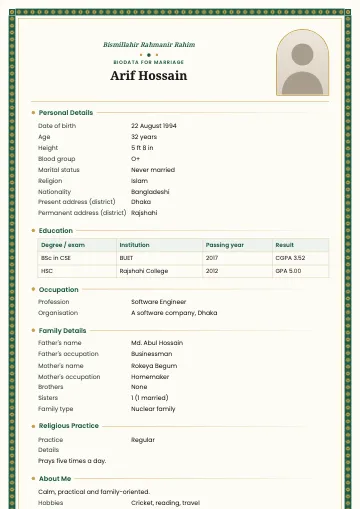
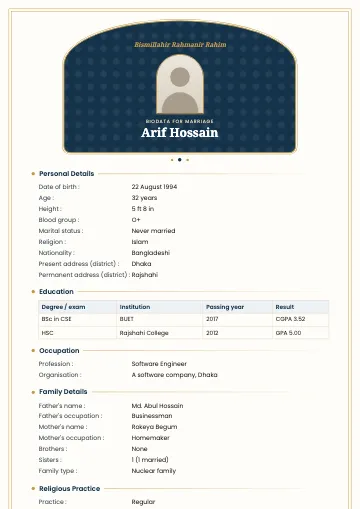
Many families begin the biodata with "Bismillahir Rahmanir Rahim". It's optional; follow your family's custom. All five Islamic templates on BanglaBiodata (Islamic, Noor, Rawdah, Hilal and Sukoon) include it, and you can turn it off in one click in the "Arrange & settings" step.
The religious practice section
Add a separate section called "Religious practice" after family details. Keep it brief and honest: write only what you actually practise. For example:
- Salah: five times daily / trying to be regular
- Fasting: all of Ramadan
- Quran: can recite correctly
- Hijab (for a bride, if relevant): observed
- Other: interested in learning more about the deen
Sample: I pray five times a day and fast during Ramadan. I can recite the Quran correctly. Our family has a deeni environment.
Don't exaggerate; a mismatch discovered after meeting destroys trust. And if there's something you'd rather not share, leaving it out is perfectly fine.
The family's deeni environment
Many families want a sense of the household as a whole. One line with your family details is enough, for example: "Everyone in the family prays and is religious." In BanglaBiodata, use "+ Add a field" to add any line like this.
Deen in your expectations
If religiousness matters to you, say so plainly in the expectations section: "Looking for a practising, regularly praying partner." Being clear from the start brings proposals that actually fit.
Photos and privacy
Many Muslim families, particularly for a bride, prefer not to show a photo to everyone at first. Some options:
- Leave the photo out and send it separately once a family shows interest.
- On a share link, blur or hide the photo: your own downloaded copy keeps it, but people with the link won't see the real photo.
- Choose a modest photo in simple clothes against a plain background.
What doesn't belong in a biodata
Mahr, wedding arrangements or any financial terms aren't for the biodata; families discuss them directly as things progress. And never include sensitive details like your National ID number or full address.
Which Islamic template?
- Islamic: green and gold geometric star border; the traditional choice.
- Noor: a midnight-blue mihrab arch header; refined and modern.
- Rawdah: emerald frame with ornate gold corners; festive and formal.
- Hilal: white and minimal with a crescent and a geometric side band.
- Sukoon: calm sage and beige with soft cards; a modest Gen Z look.
For general format rules, see the marriage biodata format for Bangladesh.
Frequently asked questions
- Is Bismillah required on an Islamic biodata?
- No, it's optional. All our Islamic templates let you turn it off in one click.
- What goes in the religious practice section?
- Briefly, what you actually practise: salah, fasting, Quran recitation and, if relevant, hijab.
- Does a bride's biodata need a photo?
- No. Many families send it without a photo at first, or blur the photo on share links.
- Which Islamic template should I choose?
- Islamic or Rawdah for tradition, Noor or Hilal for a modern look, and Sukoon for a soft Gen Z style.