Biodata vs CV vs Resume: What's the Difference?
Published:
No login to start, ready in 5 minutes, free PDF download.
Make your biodata free"Biodata", "CV" and "resume" are often used as if they mean the same thing. They don't, and sending the wrong one is a common mistake, especially for a marriage proposal. Here's the difference in plain terms.
Biodata
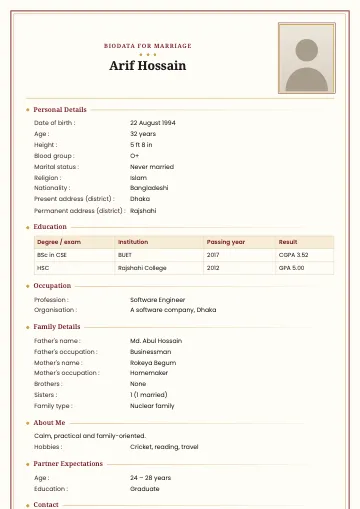
Biodata is short for biographical data. Originally it meant any summary of a person's details. In Bangladesh, India and Pakistan today, it almost always means a marriage biodata: the document families exchange when a marriage proposal begins.
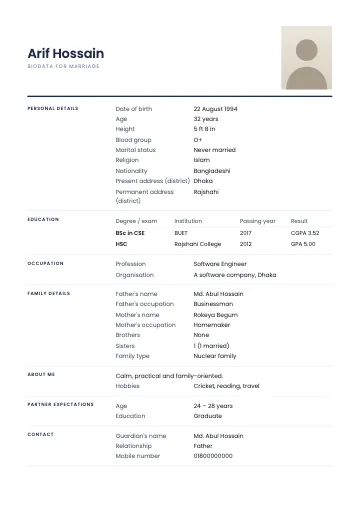
A marriage biodata typically contains:
- Personal details: date of birth, height, marital status, religion, district
- Education and occupation, briefly
- Family details: parents, siblings, type of family
- About me
- Partner expectations
- A guardian's contact details
It's usually one page, sometimes two. See the full marriage biodata format for Bangladesh.
CV (curriculum vitae)
A CV, Latin for "course of life", is a complete record of your academic and professional history: degrees, research, publications, teaching, jobs, awards and references. It can run to several pages and is used for academic posts, research, scholarships and many jobs outside North America.
A CV does not include family details, religion or partner expectations.
Resume
A resume is a short, targeted version of a CV, usually one page, tailored to a specific job. It highlights the skills and experience most relevant to that role. Resumes are standard in North America and common in Bangladesh's private sector.
At a glance
- Purpose: biodata, a marriage proposal; CV, academic or professional applications; resume, a specific job.
- Length: biodata, 1–2 pages; CV, as long as needed; resume, usually 1 page.
- Family details: biodata, yes; CV and resume, no.
- Photo: biodata, often (optional); CV and resume, depends on the country, increasingly no.
- Contact: biodata, usually a guardian; CV and resume, yourself.
What about a "marriage CV"?
Many people, especially in cities and abroad, call a marriage biodata a "marriage CV". It's the same document; the name just suggests a cleaner, CV-like design. See our marriage CV maker.
Common mistakes
- Sending a job CV for a marriage proposal: the other family learns about your projects but nothing about your family or what you're looking for.
- Putting family details on a job resume: irrelevant to employers, and personal information you don't need to share.
- Including sensitive data in either: never your National ID number, passport number or bank details.
Make the right document
For a marriage biodata in English or Bangla, use the free biodata maker: pick a template, fill in a simple form, and download a PDF, image or Word file. For the English format specifically, see English biodata format for marriage.
Frequently asked questions
- What does biodata mean?
- Biodata is short for biographical data: a summary of a person's personal details. In Bangladesh and South Asia today, the word usually means a marriage biodata.
- Can I use my CV as a marriage biodata?
- No. A marriage biodata needs family details, partner expectations and a guardian's contact, and doesn't need your work achievements in detail.
- Is a biodata used for jobs?
- Some government and older application forms still say "biodata", but most employers today expect a CV or resume.
- How long should each be?
- A marriage biodata: one or two pages. A resume: one page. A CV: as long as your academic and professional history needs.